
If you're researching a hair transplant abroad, you've almost certainly come across Turkey and Tunisia — the two destinations that dominate this space for European and North American patients. Most comparison articles online just repeat the same three data points (price, price, and price) without explaining what actually differs beyond the number on the invoice. This guide goes further: real pricing ranges, how techniques are chosen, what the process actually looks like day-to-day, and where each destination genuinely has an edge.
Hair Transplant Cost — Tunisia vs Turkey
Based on current market rates across accredited clinics in both countries:
- FUE (average): Tunisia €1,500–€2,800 | Turkey €1,500–€3,500
- DHI (average): Tunisia €2,800–€3,600 | Turkey €2,500–€5,000+
- Per-graft, where itemized: Tunisia ~€1–€3 | Turkey ~€0.65–€1.10
- Market size: Tunisia — smaller, more selective clinic network | Turkey — world's largest hair transplant market, 1M+ procedures/year
These ranges come from cross-referencing current published pricing across multiple accredited clinics in each country — not a single source, and not a fixed quote. Your actual price depends on graft count, chosen technique, and your specific case, which is why any clinic worth trusting will only give you a firm number after reviewing your scalp and hair loss pattern, not before.
The headline takeaway: Turkey isn't dramatically cheaper than Tunisia. The two overlap significantly in price. Turkey's range is wider mainly because its market is so much larger — spanning high-volume budget clinics up to premium ones — while Tunisia's smaller, more curated network keeps pricing in a narrower, more predictable band.
How Technique Is Actually Chosen (Not Just Listed)
Every serious clinic — in Tunisia or Turkey — offers FUE, DHI, and Sapphire FUE. Where guides usually stop at naming them, here's what actually decides which one fits you:
- FUE (Follicular Unit Extraction) is typically the default for larger sessions and higher graft counts, since it allows faster extraction across a wide donor area. It's usually the more budget-friendly option.
- DHI (Direct Hair Implantation) places each graft directly using a specialized implanter pen, without pre-made incisions. It tends to be chosen for hairline work and areas where precise angle and density control matter most — the trade-off is a slower procedure and typically a higher price.
- Sapphire FUE uses sapphire-tipped blades for the incision stage, which some surgeons prefer for denser packing and faster healing, particularly on larger sessions.
In practice, patients with early-stage thinning (roughly Norwood 2–3) needing 1,500–2,200 grafts are commonly good candidates for FUE alone. Patients with more advanced loss (Norwood 5–6) needing 3,500+ grafts often require a combined approach or staged sessions across techniques. This is exactly the kind of assessment that should happen during a real consultation with photos — not something any article, including this one, should tell you definitively without seeing your case.
What the Process Actually Looks Like
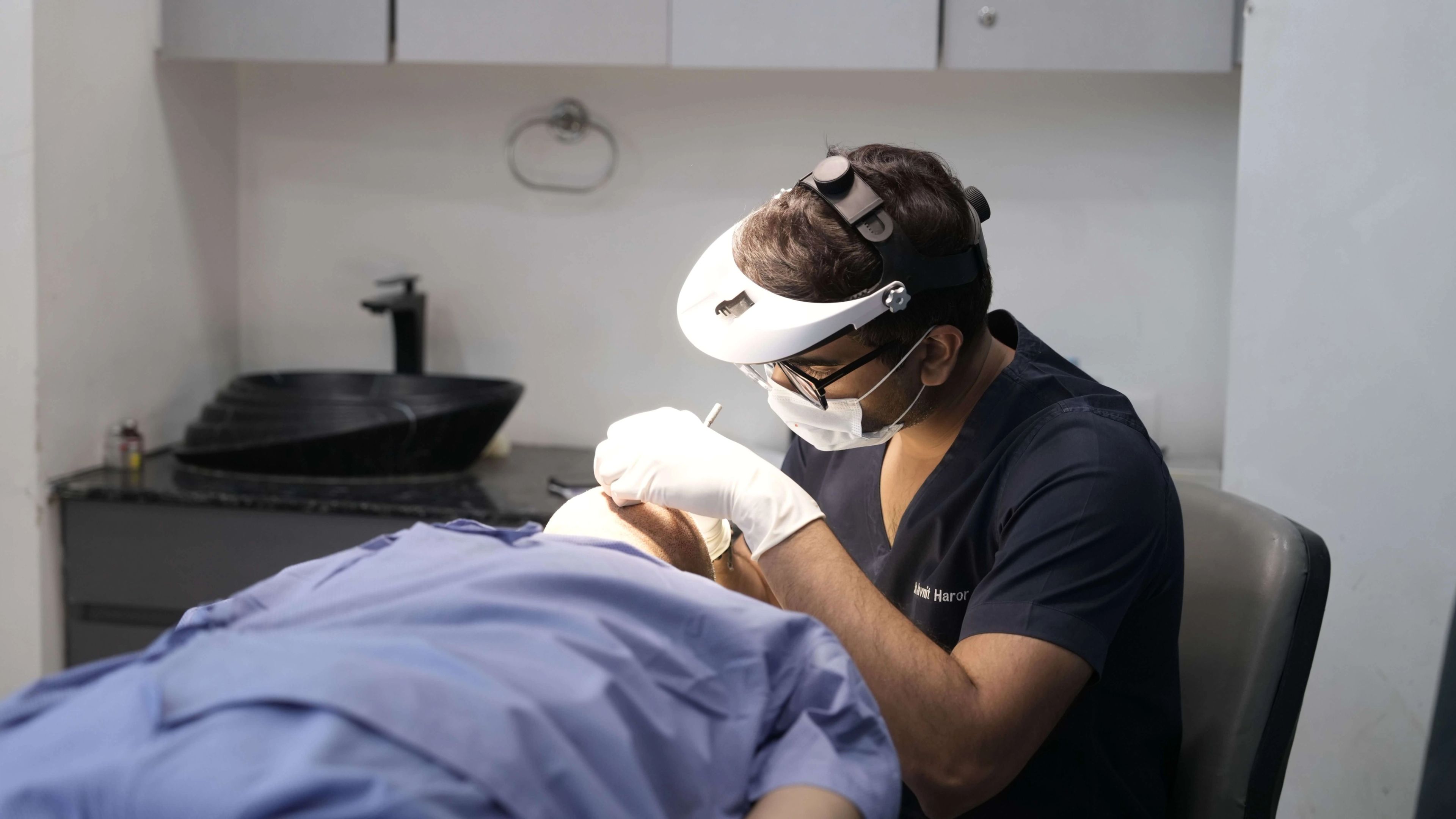
Most patients follow a similar rhythm in both countries: arrival, consultation and scalp assessment, procedure day (typically 5-8 hours depending on graft count and technique), a follow-up check the next day, then a few days of rest before flying home. Most patients plan for 4 to 7 days on the ground.
That said — and this matters more than most guides admit — there's no single timeline that applies to every patient. Graft count, your donor area density, how your scalp responds day-to-day, and the specific technique used can all shift this. Anyone giving you a guaranteed fixed schedule before reviewing your case is skipping a step they shouldn't skip.
Visible regrowth typically begins around month 3-5, with final density and texture visible between month 12 and 15 — again, a general pattern, not a promise for any individual body.
Where Tunisia Genuinely Has an Edge
- A smaller, more curated clinic network — Tunisia hasn't scaled to the ultra-high-volume "hair mill" model some budget Turkish clinics are known for, which several patient reviews and industry guides flag as a risk factor for rushed, assembly-line procedures.
- Shorter, often cheaper flights from most of Europe, meaningful for anyone balancing travel cost against the procedure itself.
- Strong clinical ties to French medical training and standards, with French-language care as the norm rather than the exception — relevant for francophone Europe and Canada.
- JCI-accredited partner facilities, with the same accreditation standard used to evaluate hospitals internationally.
Where Turkey Genuinely Has an Edge
Fairness matters here, since a page that only praises one side isn't useful to you as a reader.
- Sheer procedure volume — Turkish clinics collectively perform over a million hair transplants a year, which means individual surgeons often accumulate case experience faster than in smaller markets.
- More competitive pricing at the budget end, if minimizing cost is your primary constraint over everything else.
- The most mature medical-tourism infrastructure built specifically around this procedure — dedicated hotel partnerships, VIP transfer networks, and an entire local economy built around hair transplant patients specifically.
The honest conclusion: both destinations can deliver excellent results. The country matters less than the specific clinic's accreditation, the surgeon's actual case experience, and how transparent the quote process is before you commit.
The HEAL U Difference
We don't publish individual clinic or surgeon names publicly — not to hide anything, but because our role is to vet, coordinate, and stand behind your entire journey rather than hand you a name and step back. In practice, that means:
- We only work with partner clinics that meet accreditation standards we've personally verified, not just ones that advertise well.
- Every quote is built around your actual case — graft assessment, technique fit, and realistic timeline — not a generic package price.
- You have a single point of contact before, during, and after the procedure, including coordination if anything about your case needs adjusting mid-process.
- If something about your experience doesn't match what was promised, you have someone accountable on your side — not just a clinic that's already been paid.
Is a hair transplant in Tunisia safe?
Yes, when performed at an accredited clinic by an experienced surgical team. Always verify accreditation (JCI, ISO 9001) and ask for the surgeon's case experience before booking, regardless of destination.
How much does a hair transplant cost in Tunisia vs Turkey?
Tunisia typically ranges €1,500–3,600; Turkey ranges €1,500–5,000+. The two overlap more than most guides suggest — clinic quality and technique vary more than country does.
What's the difference between FUE and DHI?
FUE extracts and implants grafts in two separate stages and suits larger sessions well. DHI implants each graft directly with a specialized pen, often chosen for hairline precision, typically at a higher cost.
How long do I need to stay in Tunisia for a hair transplant?
Most patients plan for 4 to 7 days, but this depends on your graft count, technique, and individual healing — there's no fixed answer that applies to every patient. Your exact timeline is confirmed during consultation.
Do I need to know which technique I want before I contact HEAL U?
No. Technique is determined together with the clinic during your consultation, based on your hair loss pattern and donor area — not something you need to decide in advance.
Dr Alya Soudani
An expert in medical coordination with a scientific background in microbiology, Alya founded Heal-U to bring transparency and medical rigor to health tourism. She personally supervises every patient journey.